Monday, September 19, 2011

Re-visiting, re-thinking, re-engaging

A recent discussion with a curator for an upcoming show has left me reflecting on some drawings that I haven't thought about in a long time. It is such a treat to have an outside voice plant a seed in your brain which then makes you see your own work in a new way.

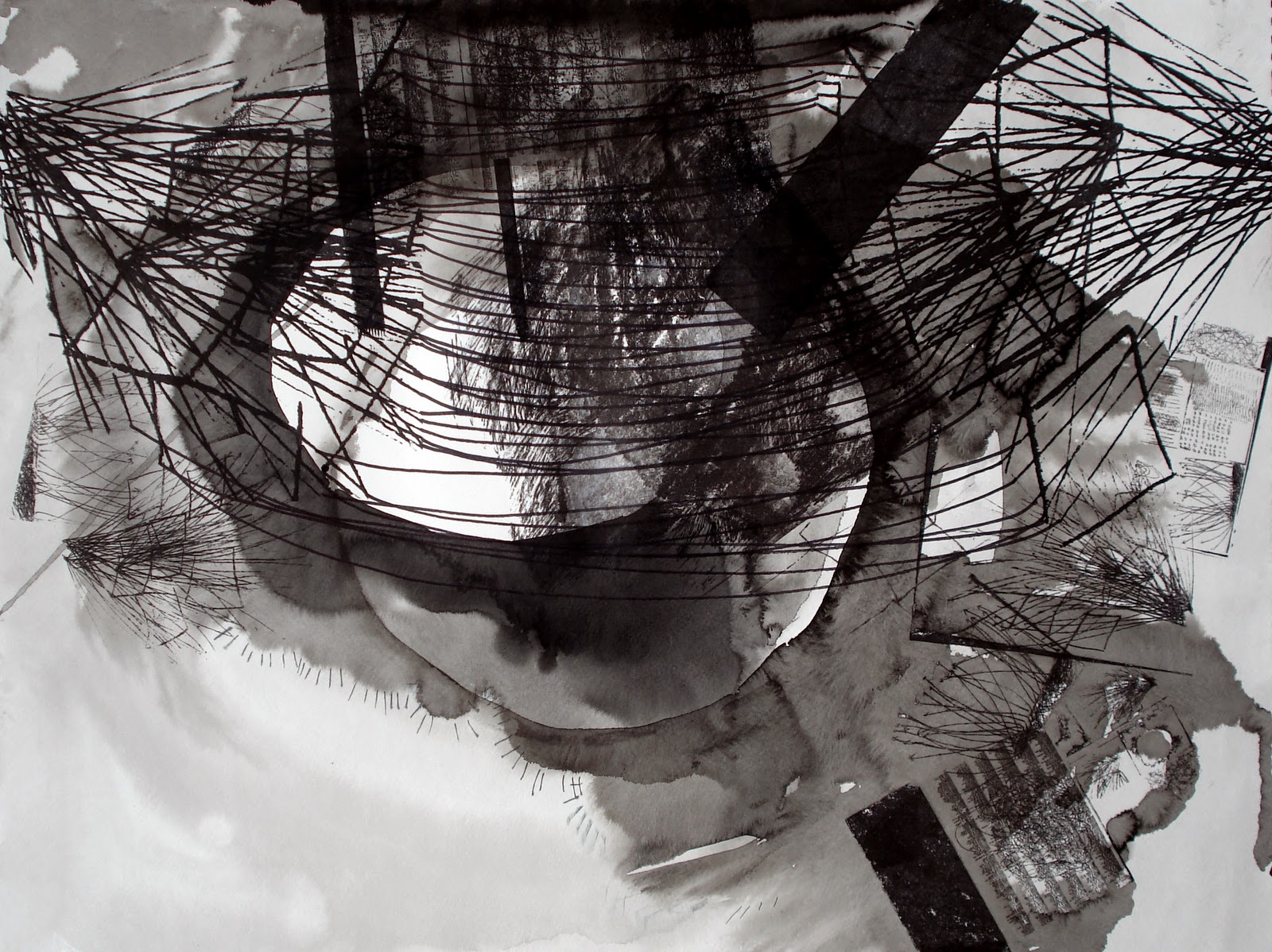
The upcoming exhibition (details soon once things are more finalized) has me thinking of transformations. The curator was interested in some drawings from 2007 from a series called "World Machines." The larger drawings use notational and gestural marks collaged together to form teeming masses—mechanisms that make me think of the movie Brazil—that teeter between a state of potential rebirth or decay. The smaller works are a bit looser/lyrical with ink washes in addition to the collaged marks.

Reflecting back is of course making me think about my current work in new ways. I'm working primarily on unstretched canvases and planting suggestions of structure within them by adding chunks of wood stretched within the fields (see Sattha's Mmmm... as an example). I hadn't thought about this work in terms of transitions before but now I see that the idea is very relevant. I have always liked my work to feel like it's caught in the process of becoming; not yet fully matured and retaining a sense of potential energy. This often makes for a fairly awkward object... and I like that too. It's as if I'm creating adolescent artworks—all knees & elbows—makes for some fun angles!

Some images from the World Machines series, all from 2007:

World Machine #1, 18x24

World Machine #2, 18x24"

World Machine #3, 18x24"

World Machine #5, 18x24"

World Machine #7, 18x24"

World Machine #8, 18x24"

World Machine #9, 18x24"

World Machine #10, 18x24"

World Machine #11, 18x24"

World Machine #12, 18x24"

Machine Garden, 40x42"

Machinescape, 58x42"

Sky Net Machine, 54x42"

Convergence Machine, 42x41"

Formulation Machine, 50x42

Thursday, June 09, 2011

New American Paintings!

I'm in for the NAP West Edition! This edition was juried by Cassandra Coblentz of the Scottsdale Museum of Contemporary Art:

Cassandra Coblentz is Associate Curator for the Scottsdale Museum of Contemporary Art (SMoCA). A native of Los Angeles, Cassandra has spent her career all across the country, from L.A. to New York, and her years-long focus on museum education has largely informed her practice as a contemporary curator and how she approaches exhibition-making.


Read the full interview for her views on process, emerging work, and the importance of considering viewership when making curatorial decisions at the New American Paintings/Blog. 

Exciting stuff... should be out in the fall. Now I must pick 6 images & get the 'ol paperwork together.


About New American Painting:

Thursday, June 02, 2011

Somewhat related notes on poetry

In an article titled "After the Drips" by Jerry Saltz in the April 4th issue of New York Magazine, Saltz says "A lot of the work in "Unpainted" is hard to take—even ugly. Some of it looks like junk. But much of it I love because it shows how fluid and uncanny beauty and form can be. Sit with the work here and you will find you are using you imagination more than  you eyes."

On a somewhat related note, I have recently been thinking about the kinship between painting & poetry.

I have never really been a fan of poetry but the more I look into it I think I've just been lazy about it.  My dear friend Colleen Sanders recently shared the article  "Laugh While You Can" by Kay Ryan with me that, though actually about poetry, is all about painting. I particularly love this passage:
Right now I am thinking of something unlikely that I saw a few days ago, the morning after my town had experienced a major winter flood. In the middle of a residential street, a cast iron manhole cover was dancing in its iron collar, driven up three or four inches by such an excess of underground water that it balanced above the street, tipping and bobbing like a flower, producing an occasional bell-like chime as it touched against the metal ring. This has much to say about poetry.
For I do not want to suggest in any way that this aquifer under poetry is something silly or undangerous; it is great and a causer of evry sort of damage. And I do not want to say either that he poem that prompts me to laughter is silly or light; no, it can be as heavy as a manhole cover, but it is forced up. You can see it would take an exquisite set of circumstances to ever get this right.

In terms of structure, layers, dangerous hilarity, undercurrents, and the role of the reader/viewer this article and how it can apply to painting make me giddy. The parallels of painting & poetry were originally introduced to me in college by professors Michael Byron & Julie Burleigh—but it's taken me this long to really delve into the idea.

And so, again on a somewhat related note, I leave you with one of my favorite poems of all time:
Poem, by Frank O'Hara
Lana Turner Has Collapsed!
I was trotting along and suddenly
it started raining and snowing
and you said it was hailing
but hailing hits you on the head
hard so it was really snowing and
raining and I was in such a hurry
to meet you but the traffic
was acting exactly like the sky
and sudenly I see a headline
LANA TURNER HAS COLLAPSED!
there is no snow in Hollywood
there is no rain in California
I have been to lots of parties
and acted perfectly disgraceful
but I never actually collapsed
oh Lana Turner we love you get up

Thursday, May 05, 2011

Friday, April 29, 2011

NAP contenders

Ceegee!, 5"x5" 2010

Satha's...mmmmm, 20" x 46" 2010

Trophy, 22" x 16" 2010

Ahbwak, 11" x 17" 2010

Wednesday, April 13, 2011

"Not" installation at TSK!

Ahbwak, 2010
For those in the Wichita area, today marks a special day! Our own local & beloved Tanya Tandoc is opening the new & improved Tanya's Soup Kitchen! I am pleased to have a new painting installation up for the occasion. Details below, photos to come!

"Not"
finished, unstretched paintings on canvas & linen
site-specific installation, April 2011

Tanya's Soup Kitchen
1725 E Douglas at Kansas

Sunday, January 16, 2011

Apple & Asafetida in painting!

Reading an article in the New Yorker about pastry chefs & the evolution of dessert & one particular passage was a great parallel to painting:

asafetida
"The key thing for a cook is to develop a library of flavors that you can recall. If I say to you, 'Apple & cinnamon,' you would click in immediately. 'Yes, apple! Yes, cinnamon!' The library of your mind contains that. But what if I say "Apple, asafetida'? Nothing! You have nothing stored there." He added slyly, "Now, this is a benefit to the chef, because if I do apple and cinnamon and you don't like it you think there's something wrong with me, but if I do apple and asafetida and you don't like it there's something wrong with you." He laughed briefly, professionally. "The development of a pastry chef is not the development of techniques. It is the slow, careful development of a catalogue of savors and flavors, which you can develop the way you develop muscles. There is a logic in every dessert worth eating. Consider the logic of white peach and rich cheese. We must be conditioned not by sight but only by flavor, the tongue, the nose, and the feel in the mouth."

Really?, mixed media on paper, 2009
An artist who really wants to push her/himself and make something new must develop a cache of flavors as well... but in doing that cannot just "paint" apple & cinnamon over & over again. Doing apple & cinnamon over & over makes you a baker/crafter/artisan not a true artist. I love apple & cinnamon but that combo isn't going to teach me anything. Apple & asafetida? I have no idea what the hell that is. That is exciting. As an artist, it's my job to push comfort zones stretch our collective ideas of "flavors" because only by letting new information & experience into our lives do we grow & learn as individuals & as a society.

There is a logic in every artwork worth experiencing. However, if you approach said artwork with your own apple/cinnamon baggage, your experience will be that much more skewed. However, if an artist can present you with apple & asafetida, then you are forced to approach like a child & take in something new. What a beautiful thing... if we were really able to take in new experience like a child & notice our own processing with freshness!

Saturday, November 06, 2010

Saturday in the Studio

Some work in progress... all unfinished, all cell-phone pictures... nothing too serious, just a glorious work day.
Trophy, mixed media on linen, 16" x 17" 2010

Trophy, detail


Monday, November 01, 2010

installation photos

"...i know you" exhibition at Bob Schwan Studios with Trish Higgins Fine Art!
thanks again to all for your support. The larger pieces are all from a couple years ago, the smaller works ongoing from the past 2 years. The items in the drawing installation include brand new works on paper and canvas, drawings, studio scraps, and important pieces of writing—some extending back almost a decade. 


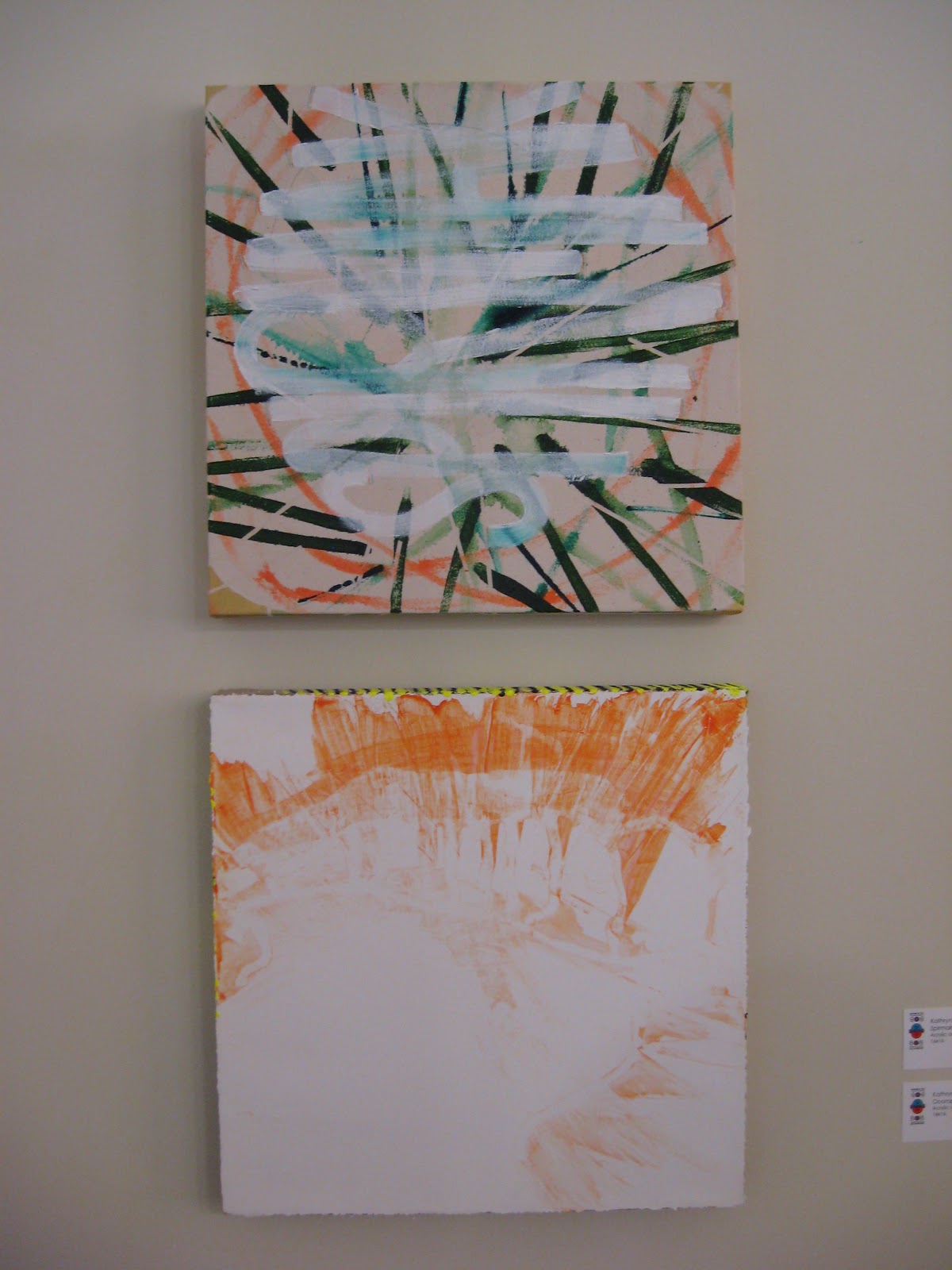
...Leads to Blue, Aneblefa, Kagren (top pink), Ceegofi (bottom yellow), MaJoot, Ofeko

...Ahh, Yes, Muhunse, ...Leads to Blue

Spirmak (top), Ooorapa (bottom)

...Ah, Yes, Murhunse, ...Leads to Blue, Aneblefa, Kagren, Ceegofi

Kaypowla


Drawing installation in the loft

Drawing installation in the loft

Drawing installation & a painting so new it doesn't have a title yet

Drawing installation

Two brand new, currently untitled, paintings

Drawing installation

Drawing installation including email with the best passage about intuition (*see below for text)

Akka, Ahhbwak in the drawing installation

drawing on velum, shark illustration, Moo-i, and note from Amy Sillman lecture that says "stop trying to finish every painting the moment you start one"

*Definition of intuition: from a Williams Alumni Magazine.  
Mike Glier '75, Studio Art

Being creative in the studio requires a kind of mental state that is sometimes referred to as right-brain thinking. Some call it intuition, but I don’t like that word because it makes it sound as if a creative state of mind is mysterious, as if it’s sent to you from above. That’s total baloney. Being creative in the studio is an intellectual process that’s not verbal. It’s a very synthetic process wherein your brain is constantly comparing your sensory awareness of the moment to your memory of similar moments in the past. It’s not a verbal comparison; it’s happening at a nonverbal level. And you’re able to react to the problem of the moment very spontaneously, without a verbal engagement. Then later, you go back to language. You switch back to the left brain and do a critical analysis of what you’ve done.
Mike Glier, May 3, 2006, 58°F, N42º 52.635, W 73º 20.717 (The Garden)

Saturday, October 30, 2010

I'm having a love affair with this book!

My fabulous friends Jennifer Beattie & Kurt Marsden gave me this book of essays and I have been off & on reading it for the past year & a half. Right now I'm fully in love with it. Here are a couple passages for you to chew on.

Eric Wesselow's stained glass, Humber Valley United Church in Toronto


The Way of the Maker: Eric Wesselow's Life Through Art

p. 33: Making or Breaking: Art as Education

"... I propose the universal model, art, as a catalyst. By 'art' in this context, I think in particular of two areas of human engagement. One is what Maslow calls 'self-actualizing creativity.' It is something he finds a painter or sculptor or pianist may not necessarily have, but a fulfilled housewife and mother may richly possess and display. She may be original, ingenious, unexpected, inventive—her first-rate soup more creative by far than a second-rate painting or poem. There are no minor arts, only minor artists.
... What has not happened to the child will likely happen to the adolescent or adult: the maiming, the atrophy of the creative urge by a world of purpose.
... It [art] stimulates our thought processes by way of productive thinking—the relationship between thinking and making grounded in touching the material, most important in today's industrialized world where our only manual activity seems to be pushing buttons and turning dials. It involves the constant training of all our senses, including the kinesthetic and the enteroceptive both of which help promote empathy. The arts are singularly suited to project understandings which cannot be otherwise known or experienced."

And, one more short one:
p. 22 I Never Know How or Why: Probings into the Processes of Art Work

"When a new skill has been perfected, so to speak, its functions tend to become automatic. This may involve the perceptual, the manual, and the cerebral functions. Skill easily becomes stereotyped and dominates the art work. This can lead to a lazy and shallow mind. ... virtuosity stands in the way of originality. Great mastery of a skill often induces an automatic technique or process. Acquiring steady hapbit can interfere with awareness and discovery..."

MMMMMM! Yum! Love it!

Thursday, October 28, 2010

Juror for WSU's "Requires Two Coats" MFA exhibiton

I had the pleasure/daunting task of judging the "Requires Two Coats" MFA exhibition for Wichita State University this week. It was a very fun experience overall! Here is the Juror's Statement I wrote for the show, which is hosting a reception tomorrow night at Shiftspace in Old Town.

The first thing to hit me, upon walking into the exhibition, is a considered sense of craft present in all the works across genres. To choose particular works over others is both an honor and a very daunting task to be certain. I believe the only appropriate way to approach this task is to consider each piece individually, and then use the artist's own statement to enrich and enhance those first impressions. The overall process of "judging" is less about one work vs. another-but rather each piece vs. itself. 

This exhibition presents a satisfying variety of themes and mediums with emphasis on strong forms. Some highlights include: Eriberto Biera's painting, which presents a visual rhythm of bold colors, figures, and shapes humorously and suggestively "vandalized" with text and drawing in marker—both undermining as well as informing the painting below. David Hellman's ceramic pieces feel trickily familiar and overly comfortable until their charmingly clunky cleverness reveals itself. Across the room, Zachary Presley's collaged icons, printed and presented so simply they seem almost irreverent, raise questions of mass culture vs organic bodies (both ours as consumers and the animals visible). Lauren Clay's pieces question and celebrate their medium while remaining visually lyrical. Phillip Baumer's tangled installation confronts the viewer with its presence in 2, 3, and 4 dimensions and suggests our considered participation, its action and space. Nathan Carris Carnes's playful sculptures are physically seductive and seem to ooze their suggestive undertones in a very polished way. Amy Yun-Ping Chen's paintings are puzzles with layers and fragments of visual and cultural reference, cheekily presenting stereotypes as you find both your eyes and brain immersed in her (de)constructed "landscapes."

Overall it is a pleasure to delve into the products of each artist's efforts and deliberations—particularly during such a powerful and transitional time as their graduate study. I would like to thank Shift Space and WSU for the opportunity and all the artists for offering their work for us to chew on. 

-Kate Van Steenhuyse

Tuesday, October 26, 2010

Artist's Talk - "i know you..." exhibition

Tomorrow I'm de-installing my show here in Wichita. Thank you to all who came out to see it & support my work!
Below is a video of the talk I gave at the opening, enjoy!

Tuesday, September 21, 2010

"i know you..." Opens this weekend!

Ceegofi, Acrylic & Spray Paint on Canvas

I will be showing large-scale and small-scale paintings from the past 2 years as well as a group of drawings, sketches, small construction-y paintings, and notes. 

See below for more details!